Mostrando entradas con la etiqueta Arts & Crafts. Mostrar todas las entradas

viernes, 23 de octubre de 2015

Arts & Crafts 5º: Models

Does this ship look familiar? ;)
As part of our Unit 2 in Arts & Crafts, we have been talking about models and scale. 

It isn't always possible to draw things exactly the size they are in real life, so we use scale to represent these things and make them bigger or smaller. Imagine having to draw a ship the size it is in real life, what kind of paper should we get?

We can make models of very different things and many of you were curious about getting a model of a ship inside a bottle, so I have looked a little into it and brought you a couple of videos to see how it is done. 


Also, I have been looking for some different models and I found out that in the Museo del Ferrocarril, there is a model of a train that really works (It moves around). It is only functioning certaing days and hours, so click here if you want to get the full information in Spanish. 

This model is made in scale 1/87, in which 3,5 mm are representing 30,4 cm. 


More models:


Do you know any more models? Leave a comment if you do!

viernes, 16 de octubre de 2015

Arts & Crafts 5º: Figures in proportion

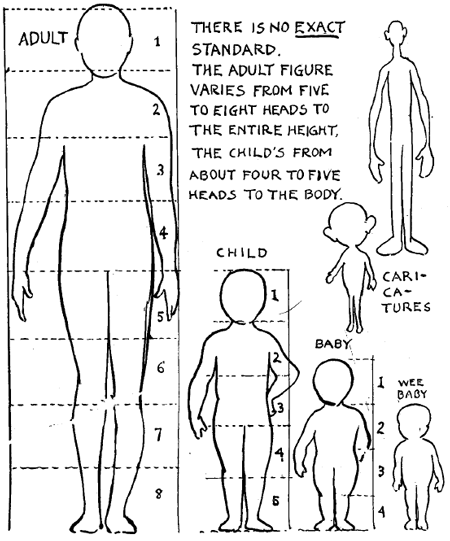
Hi! In this Arts & Crafts unit, we are drawing human figures in proportion. Proportion means that we draw people close to their natural size as compared with other parts of the body. If we don't draw a person in proportion, it is a caricature (think Barbie, Phineas and Ferb or Mickey Mouse, their heads are usually too big). 


We use heads to represent a person's height. The number of heads tall someone is depends on their age and their natural height. To know that, we measure how tall we are in centimetres (ex. 163 cm.) and divide it into how tall our head is (ex. 23 cm.). The result is how many heads tall we have to be in a proportioned drawing. I am more or less 7 heads tall (You don't have a super tall teacher I am afraid). 

After finding out how many heads our figure measures, we start by drawing the "skeleton" using basic shapes like ovals and lines. And finally, we draw the facial features (nose, eyes, eyebrows and so on) and clothes.

You can also watch this video to help you understand.

See you!